

Welcome to Carolina Thermascan
The Best Tool for Breast Health Risk Assessment
Infrared Thermal Imaging is the use of an ultra-sensitive heat detection camera to observe minute changes in skin temperature which can provide clues toward understanding the processes of the human body. This procedure is able to detect subtle, vascular and physiological changes that if left unattended may over time lead to degenerative disruptive diseases.

Services
Facts and Research

Basics of Thermography
Temperature changes can indicate normal and abnormal physiologic processes in the body

About Us
Meet our Thermoscan staff including our Medical Doctor, and our Certified Thermographic Technicians

New Clients
Available services/costs and if requested, a medical consultation following the scan

Scientific Support & Resources
See what peer-reviewed medical journals are saying about thermography.

Examples of Breast Scans
The central concept is to determine if there are any areas of asymmetrical heat

Wilmington
Check out specifics on how to schedule in Wilmington and where to find us

Frequently Asked Questions
Check out some of the most commonly asked questions and their answers

Approach to Breast Screening
Thermography as the ultimate tool for long-term breast screening

Contact Raleigh
Check out specifics on how to schedule in Wilmington and where to find us
About Us
John Pittman, M.D.
Dr. Pittman has had a long-standing interest in women’s health and innovative strategies for cancer prevention and treatment. Dr. Pittman founded the Carolina Center for Integrative Medicine in 1994, he became interested in thermography to assist with breast cancer screening in women who were considering bio-identical hormone replacement therapy. It was then that he began working with Dr. Lewis Stocks, purchasing the business in 2007 with Dr. Stocks remaining on staff, continuing to read all scans until his retirement in July 2012. That year, Dr. Pittman joined the American Academy of Thermology undergoing certification training with a focus on newly established AAT breast guidelines. In 2015, Dr. Pittman underwent re-certification training by AAT focusing on new guidelines for other applications of thermal imaging, expanding the services that Carolina Thermascan now provides.

Do You Have Any Questions?

Prevention Through Discovery
It is important to be aware that thermography is not a standalone diagnostic device. It does not replace any other diagnostic procedures but is an adjunctive screening tool for the purpose of providing individuals and healthcare providers information about the body’s physiologic health. Thermography is appropriate as a safe and reliable screening device to detect changes that, if left unattended, could possibly progress into a late stage disease that can then be detected by other types of imaging devices.
Most all of us would rather be informed about potential problems before they become serious and require more aggressive intervention. Infrared Thermal Imaging is one of the most effective prevention tools available, able to provide thermographic screening as an adjunct to other clinical diagnostic procedures.
Whether referred by a health care provider or sought out individually, clients will be provided with a detailed report prepared by John C. Pittman, M.D., Certified Thermologist by the American Academy of Thermology to include the following:
Highly effective in detecting breast abnormalities and helps identify risk factors that may predispose women to breast cancer.
Involves no direct contact, carries no risk or side effects. It is pain-free, non-invasive, with no radiation exposure.
Obtains a fingerprint of breast characteristics that should remain the same in future scans enabling regular monitoring.
In recent years, thermal imaging technology has greatly improved, offering a high-sensitivity tool that can supplement mammography.
Attention to recognizable patterns of surface temperature changes as they relate to:
– Breast Health
– Head and Neck Health (Dental, Sinus, Allergies, Thyroid)
– Cardiovascular Health
– Abdominal Health
PDF Attachments containing all scanned images with:
– Regional and spot temperature details
– Side to side and other appropriate temperature comparisons
– Comparison of scans to any previously performed scans
– Recognitition of suspicious patterns of change.
Clinical Correlation and Recommendations for Further Evaluation:
– Recommendations for follow-up based on the interpreter’s experience and American Academy of Thermology Guidelines.
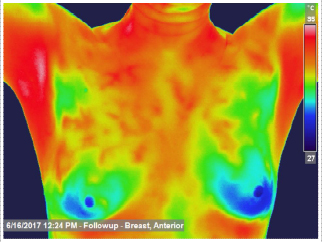
Examples of Scans
The central concept when evaluating any infrared image is to determine if there are any areas of asymmetrical heat.
TH-3: This grade is given when there is one area of asymmetrical heat and is considered equivocal.
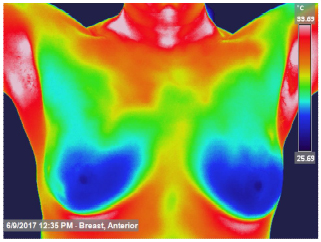
TH-1: This grade is given when there are esstentially no areas of heat observed. This is a normal scan.

Office
4505 Fair Meadow Lane, Suite 111 Raleigh, NC 27607
5725 Oleander Drive, Suite B-5 Wilmington, NC 28403
7-C Corporate Center Ct Greensboro, NC 27408
To schedule an appointment in Raleigh, Wilmington or Greensboro...
Email: kelly@carolinacenter.com
You can also call (919) 781-6999 to schedule.